
The Hidden Cost of Software Defects
Early defect detection is one of the most important drivers of software quality and delivery efficiency. Many organizations assume that software defects increase costs because of poor coding or technical mistakes. In reality, the primary driver of cost is not the defect itself, but when the defect is discovered.
In most software initiatives, the delivery process follows a familiar sequence. Requirements are defined, development begins, testing follows, and releases move forward. Early milestones appear on track, and stakeholders assume that quality aligns with progress.
However, beneath this apparent stability, small issues often begin to surface.
- A requirement may be slightly ambiguous.
- A design assumption may not fully capture business intent.
- A logic condition may behave unexpectedly under real usage.
Individually, these issues appear manageable. But as development progresses across multiple teams and system components, dependencies accumulate. Code builds on earlier code, testing builds on earlier assumptions, and release timelines tighten.
When defects surface late in the process, their impact escalates quickly. Fixing a single issue may require coordinated changes across multiple components, retesting, documentation updates, and stakeholder alignment. What could have been a simple correction early in development becomes a complex intervention across the delivery lifecycle.
Key insight: Defects themselves are not the primary risk. The real risk lies in when they are identified and how processes respond to them. Organizations that embed disciplined detection early achieve measurable business value, including potential double-digit ROI on technology investments.
Why Early Defect Detection Improves Software Delivery
Organizations that deliver software efficiently rarely eliminate defects entirely. Instead, they focus on controlling when defects are discovered.
Strong process discipline enables teams to detect issues earlier in the delivery lifecycle, where resolution is simpler and less disruptive.
For example:
- Early requirements review resolves ambiguity before development begins.
- Design validation ensures decisions are aligned with business intent.
- Continuous validation during development identifies defects closer to their origin.
When teams embed these practices into the delivery process, the workflow changes significantly. Instead of reacting to problems late in the cycle, teams resolve issues earlier when they are smaller, easier to understand, and less expensive to fix.
The result is a smoother delivery process. Dependencies remain clearer, handoffs become more predictable, and rework is contained before it spreads across the system.
Operational impact: Defect resolution shifts from a disruptive, reactive activity to a controlled and routine part of delivery. Strong process discipline ensures defects are addressed when they are small, simple, and least expensive.
Business Impact — How Process Discipline Changes the Cost Curve
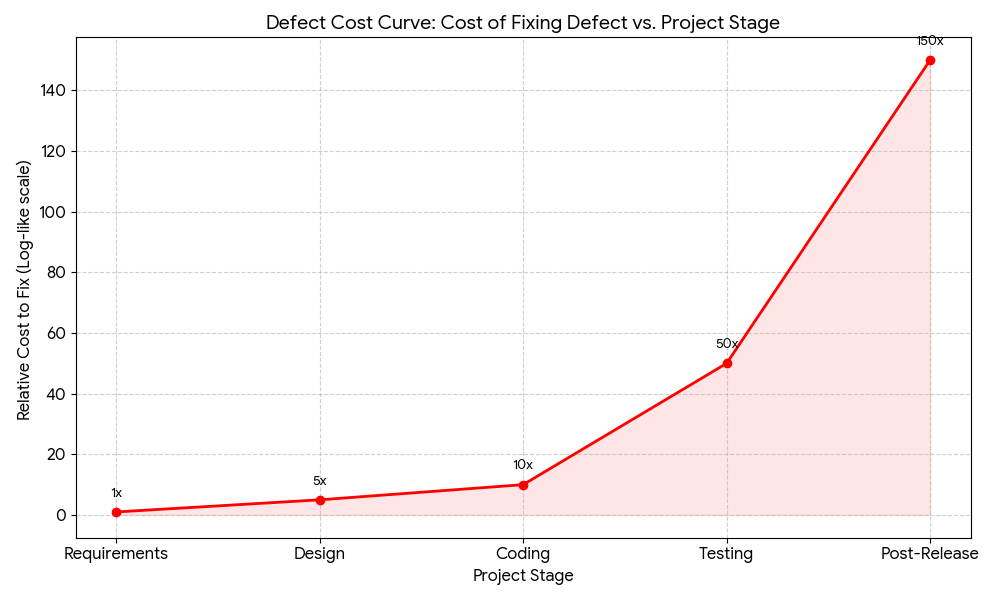
The cost of resolving defects rises exponentially as software progresses through the Software Development Life Cycle (SDLC).
| Stage | Typical Impact |
|---|---|
| Requirements | Minor clarification or documentation update |
| Development | Code modification, rebuild, and retesting |
| Formal Testing / User Validation | Wider system changes and repeated validation cycles |
| Production | Emergency fixes, redeployment, customer communication, and operational intervention |
Industry research and internal experience consistently show that production defects can cost 5–10× more to fix than those detected during early stages. This increase is driven not only by technical effort but also operational overhead and disruption to planned work.
Example Scenario
A password requirement states that passwords must contain at least eight characters.
- Clarified early: documentation update with negligible cost.
- Implemented incorrectly: code changes, rebuild, and validation.
- Discovered in production: security remediation, redeployment, customer communication, and potential reputational impact.
The defect itself remains unchanged. The difference lies entirely in when the process identifies it.
Organizations that detect defects earlier experience:
- Faster development cycle times
- Reduced rework across teams
- More predictable delivery outcomes
This shifts quality from being an afterthought to becoming a measurable business outcome.
Why Production Defects Disrupt Business Stability
Defects discovered in production introduce several operational consequences:
- Customer experience may be disrupted, requiring immediate corrective action.
- Planned development work is interrupted, diverting resources from value creation.
- Additional testing cycles become necessary to ensure system stability.
- Confidence in delivery predictability can decline internally and externally.
Early defect detection avoids these downstream costs. Resolution becomes faster, less disruptive, and contained within the development workflow.
Key principle: It is process timing, not technical capability, that determines cost, stability, and scalability.
Process Discipline as a Driver of Scalable Software Delivery
Quality assurance should not function as a final checkpoint. Instead, it must be integrated throughout the delivery process.
Effective quality practices include:
- Early requirements review to ensure clarity before implementation
- Validation scenario design to align intent with execution
- Continuous validation to prevent defect accumulation
- Automated validation to support faster and consistent defect identification
These practices stabilize delivery. Cycle times shorten, rework decreases, and predictability improves. Teams operate more efficiently with fewer interruptions while delivering value consistently.
Modern engineering teams often strengthen these practices through continuous integration approaches
Organizations adopting these practices can achieve measurable business impact, including improved ROI, faster time-to-market, and operational scalability.
Leadership Takeaway Process Discipline Determines Cost, Stability, and Scalability
Defects are inherent in software development. Their presence is not the primary risk; the risk lies in when they are discovered.
Organizations relying on late detection often face higher costs, slower delivery, and operational instability. Those that embed early detection into their processes create a fundamentally different operating model.
This approach enables outcomes such as:
- Potential double-digit ROI on software investments through reduced defect costs and rework
- Faster time-to-market with more predictable delivery
- Operational scalability without proportional increases in cost or disruption
At scale, execution reliability not defect absence determines whether technology investments deliver sustained business value.
By embedding strong process discipline, organizations can transform defect management into a strategic lever for measurable business outcomes.