
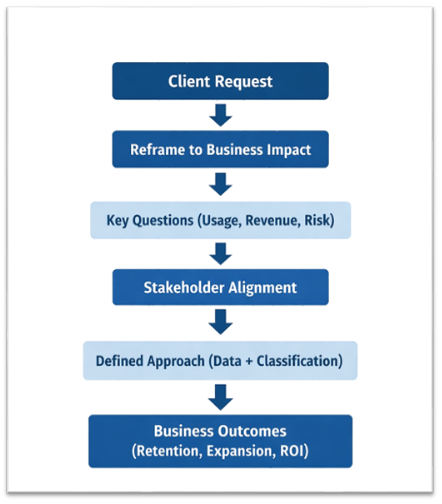
Business-aligned software development is what transforms software initiatives from feature delivery into measurable revenue impact.
A recent client request sounded deceptively simple:
“We’d like to track user login activity and classify engagement levels.”
On the surface, it looked like a straightforward reporting feature.
Track logins.
Categorize users.
Display the data in a dashboard.
But the real conversation was not about analytics.
It was about revenue.
That single request became a discussion about:
- Customer retention
- Renewal predictability
- Expansion opportunities
- Revenue risk visibility
- Decision acceleration
This is the difference between traditional delivery and business-aligned software development. Explore our Software Development Services to see how outcome-driven execution improves ROI.
High-impact technology initiatives are not defined by what gets built.
They are defined by the business outcomes they enable.
What Is Business-Aligned Software Development?
Business-aligned software development is the practice of connecting technology decisions directly to measurable business objectives.
Instead of focusing only on feature delivery, organizations evaluate:
- Revenue impact
- Operational efficiency
- Customer retention
- Growth enablement
- Strategic value
The goal is not simply to deliver software.
The goal is to improve business performance through technology. According to McKinsey Digital, organizations that align technology initiatives with business strategy are more likely to achieve measurable transformation outcomes.
The Problem With Traditional Feature Delivery
In many organizations, feature requests follow a predictable path:
- Requirements are collected
- Development begins
- Features are delivered
- The project closes
But one important question is often missing:
What business decision will this feature improve?
Without alignment between technology and business objectives:
- Teams build features without measurable impact
- Stakeholders interpret success differently
- Investments expand without clear ROI
- Product complexity increases while value remains unclear
This creates a gap between software delivery and commercial outcomes. Our Digital Transformation Consulting Services help organizations align technology execution with measurable business goals.
Reframing Feature Requests Around Revenue Impact
Instead of immediately discussing implementation details, the conversation shifted toward business impact.
We explored questions such as:
- What defines an “active” customer from a revenue perspective?
- How does engagement influence renewals or expansion opportunities?
- Should declining usage trigger intervention workflows?
- Which teams need visibility into engagement trends?
- What revenue risk exists if disengagement goes undetected?
- What business decisions will this insight improve?
This reframed the initiative entirely.
The discussion moved from:
- dashboards → retention strategy
- reporting → revenue visibility
- activity tracking → business intelligence
From Reporting Feature to Revenue Optimization System
Within the same session, the strategic foundations for execution became clear.
Business-Aligned Execution Framework
We established:
- A data instrumentation strategy tied to business decisions
- Behavioral classifications aligned with customer lifecycle stages
- Stakeholder visibility across revenue-impacting teams
- Investment assumptions connected to measurable outcomes
By the end of the discussion:
- Scope ambiguity was eliminated
- Business intent became explicit
- Stakeholder accountability was aligned
- Investment rationale was tied to measurable impact
The initiative stopped being a reporting enhancement.
It became a customer retention and revenue optimization system.
Why Business-Aligned Software Development Matters
When technology initiatives are aligned with business objectives, execution becomes significantly more effective.
Without alignment, organizations often experience:
- Conflicting priorities
- Wasted development effort
- Low adoption rates
- Delayed decision-making
- Poor software ROI
With alignment:
- Teams make faster decisions
- Product investments become measurable
- Stakeholders operate with shared objectives
- Revenue-impacting risks become visible earlier
Most importantly, software becomes a business growth lever—not just an operational tool.
1. Engagement Intelligence Improves Revenue Retention
User engagement data is not simply a reporting function.
It enables:
- Early churn detection
- Faster intervention workflows
- Better renewal conversations
- Smarter expansion targeting
- More accurate customer health visibility
In many growth-stage environments, engagement intelligence contributes directly to:
- Improved retention predictability
- Faster response to declining accounts
- Better expansion prioritization
This transforms analytics from a visibility layer into a revenue protection mechanism.
2. Investment Discipline Improves Software ROI
One of the most important questions in any technology initiative is:
“What decision will this data help us make?”
That single question changes the conversation entirely.
Instead of treating enhancements as upsell opportunities, business-aligned teams evaluate:
- Whether the initiative improves decision-making
- Whether it accelerates measurable outcomes
- Whether it supports growth objectives
This creates disciplined investment thinking.
Every enhancement must justify capital allocation through measurable business value.
3. Stakeholder Alignment Reduces Execution Risk
This initiative affected multiple teams simultaneously:
- Sales → renewal and expansion strategy
- Customer Success → intervention workflows
- Product → feature adoption intelligence
- Leadership → forecasting and visibility
Mapping stakeholder accountability early reduced:
- Rework cycles
- Communication gaps
- Scope volatility
- Downstream execution risk
Alignment is not a soft benefit.
It is a cost-control mechanism.
4. Data-Informed Thinking Improves Decision Quality
Effective execution requires operational clarity early in the process.
This includes defining:
- Expected adoption scale
- Engagement thresholds
- Behavioral signal frequency
- Business action triggers
Clarifying these assumptions early improves:
- Forecast accuracy
- Scope stability
- Execution predictability
The initiative becomes a decision-enablement system—not simply a reporting dashboard.
5. Feedback Loops Create Smarter Product Decisions
Once implemented, engagement visibility enables organizations to:
- Identify underutilized features
- Validate customer feedback with behavioral data
- Improve roadmap prioritization
- Optimize customer communication strategies
Product decisions become evidence-based instead of assumption-driven.
This creates stronger long-term software ROI.
The Bigger Insight: Every Feature Request Is a Revenue Decision
Durable partnerships are not built through delivery alone.
They are built in moments where:
- Ambiguity is reduced
- Business value becomes measurable
- Financial exposure becomes visible
- Stakeholder accountability is aligned
- Decisions accelerate
Every feature request is a capital allocation decision in disguise.
When business intent is clarified early, even small enhancements can evolve into measurable revenue drivers.
That is the difference between building software and creating enterprise value.
Key Takeaways
- Business-aligned software development connects technology to measurable outcomes
- Feature delivery alone does not guarantee business impact
- Revenue-focused conversations improve prioritization and ROI
- Stakeholder alignment reduces execution risk and wasted effort
- Engagement intelligence can directly support retention and expansion strategies
- Every technology investment should support a measurable business decision
Conclusion
Modern software development is no longer just about execution.
It is about enabling better business decisions.
Organizations that align technology with revenue outcomes:
- Move faster
- Prioritize better
- Reduce waste
- Improve customer retention
- Generate stronger ROI from technology investments
Because the most valuable software initiatives are not the ones that deliver the most features.
They are the ones that create the most measurable business impact.
Frequently Asked Questions
Business-aligned software development connects technology initiatives directly to measurable business goals such as revenue growth, customer retention, and operational efficiency.
Business alignment ensures that software investments create measurable outcomes instead of delivering features without strategic value.
It improves ROI by prioritizing high-impact initiatives, reducing wasted development effort, and connecting software delivery to business outcomes.