
Consolidating fragmented enterprise software into unified, composable architectures
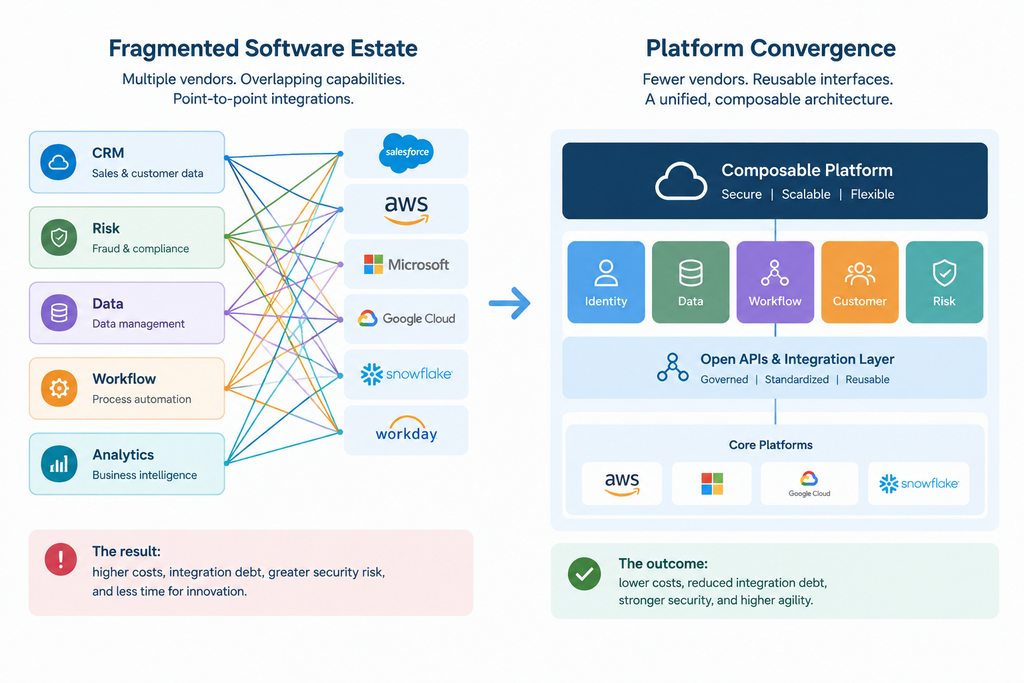
Platform convergence is becoming an important response to the growing complexity of enterprise software environments. Enterprise teams did not set out to collect dozens of overlapping SaaS products. They solved urgent problems one CRM extension, one risk engine, one data connector at a time until the stack became a patchwork of subscriptions, point-to-point integrations, and shared credentials nobody fully owns.
Platform convergence addresses this problem by bringing overlapping enterprise software capabilities into a smaller set of core platforms while preserving the flexibility to connect specialized capabilities where they genuinely add value.
Vendor fatigue is not a feeling about sales calls. It is the operational tax of paying for redundant capabilities, reconciling conflicting data models, and treating every integration as a permanent security exception.
When license renewals arrive, finance sees cost inflation without a matching productivity story. Security sees a wider attack surface: more identity providers, more brittle APIs, more shadow data flows. Delivery teams spend sprints maintaining glue rather than improving products.
The stack looks modern on a slide deck and fragile in production.
The Problem: More Tools, Less Leverage
The problem is not simply the number of software vendors an organization uses.
Enterprise teams can have a large technology estate and still operate efficiently when each platform has a clearly defined role, strong ownership, and governed integration patterns.
The problem begins when multiple tools perform overlapping functions, data is duplicated across systems, and every new application creates another integration dependency.
That creates three recurring costs:
- Redundant software spending — multiple subscriptions solving similar problems.
- Integration debt — point-to-point connections that require ongoing maintenance.
- Operational and security risk — more identities, APIs, credentials, and data flows to manage.
This is where vendor fatigue becomes more than a procurement issue. It becomes an architecture and operating-model problem.
Root Cause: Best-of-Breed Without Platform Ownership
Best-of-breed buying works when each tool owns a clear domain and integrates through governed contracts.
In practice, departments buy for local speed, IT inherits the integration debt, and no one owns platform economics the total cost of licenses, glue, and risk.
Overlap is invisible until three products claim the same workflow and none complete it without custom code.
Early fixes often fail for predictable reasons.
A pure cost-cutting purge removes tools without redesigning workflows, so teams rebuy similar software within a year.
A single “rip and replace” ERP-style program stalls when business units refuse to give up specialized capability.
Another common miss is treating integration as a project rather than a product: one-off middleware, hard-coded mappings, and credentials scattered across teams.
The root issue is not too many vendors in absolute terms.
It is the absence of a composable target architecture and an owner accountable for convergence outcomes.
Platform Convergence: A Composable Alternative
Platform convergence means consolidating overlapping capabilities into a smaller set of core platforms and exposing domain capabilities through well-defined, reusable interfaces—so teams compose solutions instead of wiring exceptions.
Conceptually, you map value streams to platform domains such as:
- Identity
- Data
- Workflow
- Customer
- Risk
You then retire redundant subscriptions where capability truly overlaps and replace brittle point-to-point links with managed integration patterns.
The goal is not a single mega-vendor.
The goal is a coherent technology estate:
- Fewer licenses for the same job
- Fewer custom bridges
- Clearer security boundaries
- Stronger platform ownership
- Reusable integration patterns
Organizations can use this approach alongside broader Digital Transformation Consulting and Software Development Services initiatives rather than treating platform convergence as a standalone technology exercise.
How Platform Convergence Improves ROI
Platform convergence should not be justified simply because an architecture diagram looks cleaner.
Convergence work earns funding when it can defend meaningful:
- License savings
- Lower integration run-rate
- Reduced operational risk
- Lower maintenance requirements
- Greater delivery capacity
That framing supports double-digit ROI discipline.
Treat each consolidation decision as an investment case:
- What capability is being retained?
- What cost is being removed?
- What integration surface is being reduced?
The business case should connect technology consolidation to measurable business outcomes rather than simply counting the number of vendors removed.
The financial discipline behind this approach also aligns with the broader technology-value principles promoted by the FinOps Foundation, which emphasizes financial accountability and business value in technology decision-making.
Platform Convergence vs. Vendor Fatigue
The difference becomes clearer when the technology estate is viewed through the lens of ownership and outcomes.
| Dimension | Vendor-fatigued stack | Converged composable platform |
|---|---|---|
| Buying logic | Local best-of-breed, project by project | Domain platforms with reuse first |
| Licensing | Overlapping subscriptions and shelfware | Consolidated capability; intentional spend |
| Integration | Point-to-point glue and exception paths | Governed contracts and shared patterns |
| Risk surface | Many identities, APIs, and data copies | Fewer seams; clearer ownership of controls |
| Success signal | Tool count or vendor discount | Cost per outcome + reduced integration debt |
The objective is therefore not to achieve the lowest possible vendor count. It is to create a technology environment where each platform has a clear purpose, ownership is visible, and integration can be governed and reused.
Illustrative Case: A Mid-Market Fintech
Consider this mid-market fintech that had accumulated separate stacks for onboarding, payments operations, customer communications, analytics, and compliance screening. Product velocity looked healthy until renewals and integration outages dominated the technology roadmap. An initial response renegotiating licenses and adding another integration layer cut some unit prices but left overlapping workflows and fragile data syncs intact.
Leadership then set a convergence mandate with named platform owners:
- Map redundant capabilities.
- Retire two overlapping workflow tools.
- Retire one underused analytics subscription.
- Replace ad hoc service-to-service links with a small set of governed integration patterns.
After roughly two quarters, subscription waste fell by about a third relative to the prior baseline, critical integration incidents dropped into a lower double-digit share of prior volume, and delivery capacity shifted from glue maintenance toward product work.
Combined license and integration run-rate efficiency improved by double digits versus the prior trajectory—without forcing every domain into a single vendor.The durable shift was not cosmetic, but architectural and economic.Organizations that keep buying point solutions for every team will keep funding redundant licenses and brittle seams.
Those that converge on composable platforms can shrink the subscription footprint and the attack surface at the same time.
What Organizations Can Do Now
Organizations do not need to launch a massive transformation program to begin addressing vendor fatigue.Start with the existing technology estate.
1. Map capabilities before renewing or adding vendors
Identify which applications perform similar functions and which business workflows depend on them.
Do this before another renewal locks the organization into another year of overlapping capability.
2. Retire true overlap
Not every specialized application needs to be removed.Keep specialized capability where the business case holds. Consolidate where multiple platforms are performing essentially the same job.
3. Treat integration as a governed product
Replace one-off integrations with reusable patterns, clear ownership, defined contracts, and appropriate security controls.
Integration should be designed for long-term operation rather than treated as temporary project plumbing.
4. Assign platform ownership
Every major domain should have someone accountable for its architecture, economics, integration patterns, and evolution.
Without ownership, convergence decisions become isolated procurement exercises.
5. Measure outcomes, not logos
A lower vendor count is not automatically a better technology strategy.
Measure:
- Cost per business outcome
- License waste removed
- Integration debt retired
- Critical integration incidents
- Delivery capacity recovered
- Security exposure reduced
This provides a more meaningful view of whether convergence is actually delivering value.
Takeaway: Convergence Is an Architecture Decision
Vendor fatigue is a platform design problem disguised as a procurement problem.
Converge overlapping capabilities into owned domains, fund only consolidations with a defensible ROI path, and measure success by cost per outcome and integration debt retired—not by logo count.
Readers can start this week by inventorying subscriptions that claim the same workflow, naming a platform owner for each domain, and requiring an integration contract before the next point-to-point connection ships.
Three principles to start with:
- Map capabilities to domains before renewing or adding vendors.
- Retire true overlap; keep specialized capability where the business case holds.
- Treat integration as a governed product, not a one-off project.
Frequently Asked Questions About Platform Convergence
Platform convergence is the process of consolidating overlapping enterprise software capabilities into a smaller set of core platforms while using reusable, governed interfaces to connect business domains.
The objective is not simply to reduce the number of vendors. It is to reduce redundant spending, integration complexity, security exposure, and technology maintenance while preserving capabilities that create genuine business value.
Vendor consolidation primarily focuses on reducing the number of suppliers or contracts.
Platform convergence takes a broader architectural view. It evaluates overlapping capabilities, workflows, integrations, data, ownership, security boundaries, and economics to create a more coherent technology estate.
Vendor fatigue is the operational burden created by managing too many overlapping software products, contracts, integrations, data flows, identities, and technology dependencies.
It can increase software costs while also consuming IT and engineering capacity that could otherwise be directed toward higher-value work.
Platform convergence can improve ROI by reducing redundant software licenses, lowering integration and maintenance costs, reducing operational risk, and freeing delivery teams from unnecessary integration work.
The strongest business cases measure these improvements against the cost of the consolidation effort.
No. Platform convergence does not require every business function to use a single vendor.
A composable architecture can retain specialized platforms where they provide genuine business value while consolidating capabilities that overlap and standardizing how systems integrate.
Organizations should first map their software capabilities to business domains, identify overlapping functionality, understand integration dependencies, establish platform ownership, and build a business case around measurable cost and operational outcomes.
The first step is understanding the current technology estate—not immediately replacing it.