
Author Info: Katyayani Lal, a Junior Quality Analyst at Insight Consultants, brings a strong foundation in both manual and automation testing, with hands-on experience using Playwright and TypeScript/JavaScript. She is known for her inquisitive spirit and passion for technology, often exploring emerging tools and experimenting with AI agents to stay ahead in her field. Beyond her professional pursuits, Katyayani finds inspiration in artistic and creative outlets—painting, sketching, and baking—while also enjoying the occasional movie or series to recharge and stay balanced.
Are you a QA engineer? Then, here’s an all too familiar story.
Each morning begins with an inbox full of updates, and inevitably, there’s another email from the product team – vague, open-ended, and lacking clarity.
“We need the app to be more intuitive. Users should find what they want faster.”
It’s the kind of requirement that sets off a chain reaction. You are left interpreting intent, making assumptions, and asking follow-up questions that may or may not get timely answers. Writing test cases becomes guesswork. Automation scripts break with every minor UI change because the logic was never clearly defined in the first place.
Days are spent chasing clarity, debugging fragile tests, and rerunning regressions that fail for reasons unrelated to actual issues. The cycle repeats…slow progress, mounting frustration, and little room to focus on the kind of work that actually drives quality forward.
For many QA testers, this isn’t an exception. It’s the norm.
But then, everything changed.
Today, AI Prompt Engineering has by large strides transformed the game. Instead of wrestling with vague requirements and brittle test cases, QA testers can now feed the AI a well-crafted prompt and let it handle the heavy lifting.
Suddenly, clarity isn’t something to chase after. It is being delivered.
Test scenarios? Generated instantly.
Edge cases? Covered.
UI checks? Streamlined with intelligent insights.
No more endless tweaking. No more decoding ambiguity. Just clear navigation, fast search, a clean interface and most importantly, time and headspace to focus on higher-value work.
AI-Powered Prompts in Testing
When given the right prompts, AI can:
- Break down vague requirements into actionable test cases
- Generate structured manual and automated test scenarios
- Guide performance and security testing
- Enhance debugging and reporting
Let’s explore how I leveraged AI in each phase of testing, using a consistent example: an e-commerce
ordering module.
Requirement Analysis: Decoding Ambiguity
The old-school approach would have looked something like this:
- Vague, incomplete requirements lead to misinterpretations.
- Stakeholders have different understandings of expected behaviour.
- Test coverage gaps appear later in the cycle.
Instead, here’s what the AI-powered approach would look like. AI helps translate vague requirements into well-defined scenarios. With a simple prompt, we can transform ambiguity into clarity:
Prompt: “Break down the following user story into functional and edge-case test scenarios: ‘Users
should be able to place an order easily.’”
AI Response:
- Verify order placement with valid payment.
- Check for error messages when entering an expired credit card.
- Validate order summary accuracy before checkout.
- Simulate network failure during payment.
- Test order cancellation flow.
And just like that, you are presented with a clear roadmap for testing. No more guesswork, no more frustrating back-and-forth.
Manual Test Case Creation: Work Smarter, Not Harder
Old-School Approach:
- Writing test cases from scratch took forever.
- Ensuring coverage for all edge cases was challenging.
- Updating test cases when requirements changed was tedious.
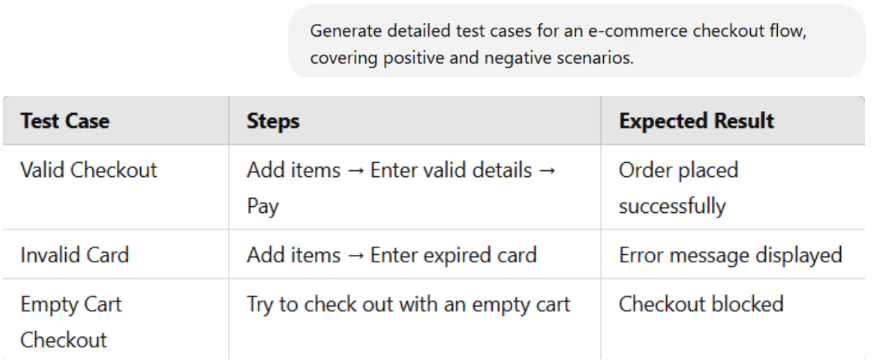
AI-Powered Approach: With the right prompts, AI can generate structured test cases in seconds. This way, you can save hours of manual effort and ensure no critical scenarios are missed. For example:
Prompt: “Generate detailed test cases for an e-commerce checkout flow, covering positive and
negative scenarios.”
Automated Testing with Playwright: AI
Old-School Approach:
- Writing Playwright scripts required time and debugging.
- Test maintenance was painful when UI changes broke locators.
AI-Powered Approach: AI-generated Playwright scripts with minimal input. No more syntax struggles or redundant coding!
Prompt: “Generate a Playwright test script for verifying successful order placement.”
And just like that, you have a fully functional script—saving you from the grind of repetitive test writing.
Performance & Security Testing: Strengthening the System
Old-School Approach:
- Performance testing setups were complex, requiring trial and error to identify bottlenecks.
- Security flaws often went unnoticed until late in development, making fixes expensive.
- Manual penetration testing was time-intensive and required deep expertise.
AI-Powered Approach: AI streamlines both performance and security testing, allowing you to proactively identify and resolve issues.
USE CASE 1: Performance Testing
With a single prompt, AI can help you generate a precise JMeter test plan:
Prompt: “Create a JMeter test plan to simulate 500 users placing orders simultaneously.”
Instead of spending hours configuring tests, you get a ready-to-run plan in minutes with no guesswork, and clear, data-driven insights.
AI Response for Performance Testing:
- Thread Group: 500 users
- Ramp-up time: 60 seconds
- HTTP Request: POST /checkout
- Assertion: Response time < 3s
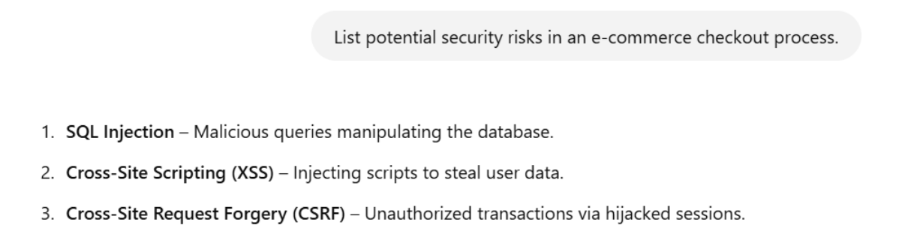
USE CASE 2: Security Hardening
To ensure your checkout process is secure, you can use AI to uncover vulnerabilities with a simple prompt:
Prompt: “List potential security risks in an e-commerce checkout process.”
Inspired and ready to hit the ground running on your own, here’s a guide to help you get started.
Universal AI Prompt Template for Testing
Universal AI Prompt Template for Testing
To streamline testing across different requirements, update the Requirement, and AI will generate tailored outputs for various testing needs –
Project/Feature: [Project Name]
Requirement Overview
[Brief description of requirement purpose, business value, and how it differs from current functionality. Include implementation considerations and conditions for feature visibility.]
Test Planning Instructions:
- Generate test cases covering functional, integration, and edge-case scenarios for the
requirement. Consolidate test cases to ensure comprehensive coverage while minimizing
redundancy. Include scenarios for different user types, payment methods, and order
scenarios. - Create a User Story for the following requirement within 50-80 words, following the format:
“As a [user type], I want to [action] so that [benefit].” - Provide a Brief Overview of the requirement including – Overview, New Requirement – Updated Behavior, Considerations, Conditions to display new requirement if any mentioned, Functional Requirement, Non-Functional Requirements, Acceptance Criteria. Also, write a brief analysis of the requirement using points.
Becoming a Testing Superhero: Key Takeaways
Incorporating AI into prompt engineering workflows can dramatically enhance testing approaches and overall productivity. The following key principles should guide effective integration:
- AI is an enabler, not a replacement. It doesn’t replace testers but makes us faster and smarter.
- The right prompt is everything. Clear, structured prompts yield the best AI-driven results.
- Consistency is key. Using a standard example (like an e-commerce ordering module) helps refine AI-generated responses over time.
- Iterate and refine. AI-generated content isn’t always perfect, but refining prompts improves result.
Prompt engineering can transform even the most time-constrained testers into high-efficiency professionals. By integrating AI tools strategically, testers can:
- Minimize time spent on manual test case creation, freeing up bandwidth for deeper testing activities.
- Rapidly generate automation scripts, enabling quicker deployments and iterations.
- Identify performance and security issues earlier in the development lifecycle.
Best of all, this approach is accessible to everyone. Testers still relying solely on manual methods are encouraged to embrace AI-driven workflows and take their testing practice to the next level. With the right tools and mindset, anyone can become a testing superhero.
Hero image by David Travis on Unsplash