
How weak monthly close discipline can turn an accounting issue into a valuation problem, told with one company’s real numbers.
The situation
A growing U.S. marketing-services business, with about $63 million of revenue in its last full year (most of it campaign cost passed through to suppliers), had what looked like a healthy finance function.
The company recorded revenue, kept bank reconciliations current and gave management a monthly P&L.
It was better than most at one thing. The company estimated and booked campaign costs before vendor invoices arrived: 20 to 37 estimate bills a month, about $7.2 million across the year.
The financial statements were not obviously wrong, but they did not consistently tell the full economic story of each month.
- Ownership-plan and long-term incentive compensation, commission adjustments and depreciation all waited for December.
- The company recognized $2.78 million of supplier credits across four spring months, and almost none since.
- Mid-way through the current year, a block of payroll was reclassified with a single catch-up entry.
At year-end, the annual numbers came out right. That created a dangerous assumption:
If the year-end numbers come out right in the end, the accounting must be working.
It was not.
The problem was not the annual P&L
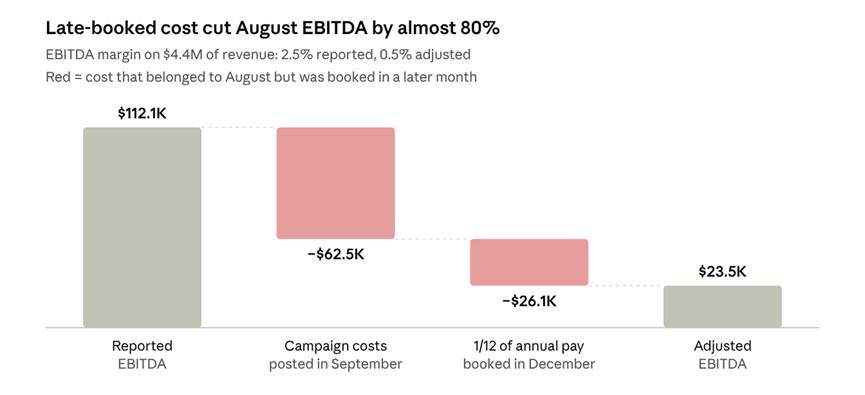
The bigger problem sat in the monthly numbers management relied on. Take an ordinary month: August of the last full year.
Source: Company accounting records · August of the last full year, reported vs adjusted
About $89,000 of cost belonged to August but sat in later months. When most revenue passes straight through to suppliers, profit is a thin layer, and a small timing shift is a large share of it.
When timing becomes a management problem
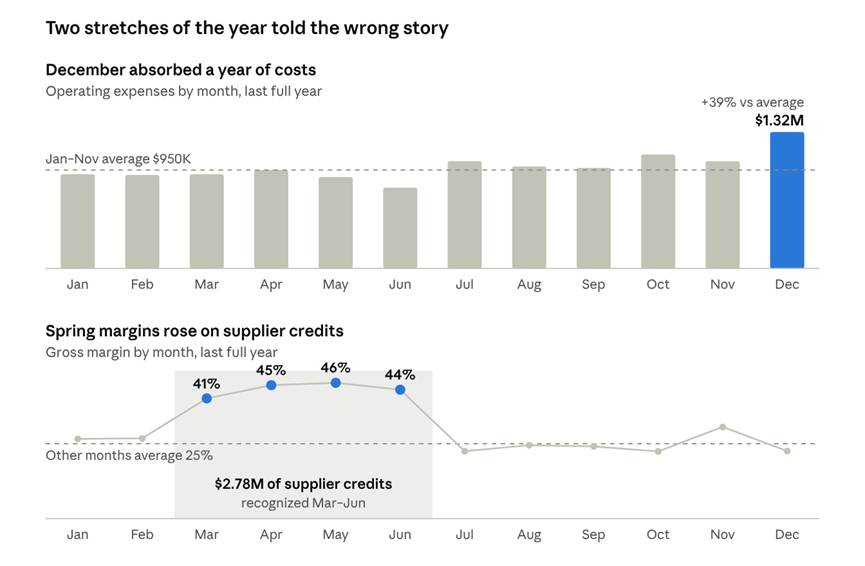
Repeated across a year, the pattern showed up twice.
Source: Company accounting records · last full year by month
December carried $313,000 of compensation and commission cost that belonged to all twelve months, so every other month looked about $26,000 better than it was. In spring, $2.78 million of supplier credits made margins look like a breakthrough. Whether they were earned then, and whether they recur, is the first thing an outside reviewer will ask.
Management spent February through November reading months that were better than they were, the months when hiring, bonuses, pricing and valuation expectations get set.
Good accounting is not simply about eventually arriving at the right annual answer. It is about reliable information when the business needs to decide.
Accrual accounting is more than entering invoices
Accrual accounting means recording costs in the month the work happens, not when the invoice arrives.
A transaction-processing team asks: “Have we entered all the invoices we received this month?”
A controllership function (which owns the monthly close) asks: “What happened economically this month that has not yet reached the accounting system?”
This business already asked the second question about its largest cost. Campaign costs, roughly 70% of revenue, were estimated in the month the work happened. In the first eight months of the current year, costs that arrived after month-end netted to minus $130,000 on $30.4 million of campaign cost. The estimates ran slightly conservative, and the gross correction was under 1%.
The gap was that the same question was not asked of everything else:
- annual ownership-plan and incentive compensation, recognized one-twelfth a month;
- depreciation, booked monthly rather than once a year;
- commissions, adjusted quarterly rather than in December;
- supplier credits earned but not yet received;
- professional fees (one fee line swung from $49,000 in January to minus $36,000 in March as an accrual was reversed); and
- classification changes, applied consistently to every month rather than through a catch-up entry.
Handling the biggest cost line well does not make the whole close reliable. Reliability comes from the close process, supporting schedules, review controls and judgment applied to every line.
Then came the transaction question
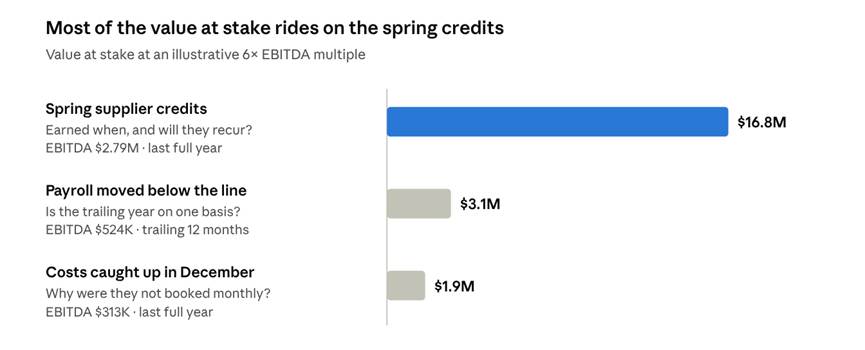
Before the December close, monthly reporting implied full-year EBITDA (operating profit before interest, taxes, depreciation and amortization) of about $7.36 million. After it: $7.05 million. At an illustrative 6× multiple, that $313,000 is $1.9 million of value, and it was the smallest question a buyer would ask.
Source: Company accounting records · illustrative 6× multiple
None of these is necessarily wrong. Each is an answer the business should be able to give, with support, before anyone asks.
When earnings are rebuilt, value can be rebuilt with them.
The balance sheet creates the second problem
Late-recognized costs mean understated liabilities at month-end. Diligence teams rebuild them from payments, payroll records and invoices received after month-end. A rebuild of this company’s balance sheet at the end of August would find:
- Well supported: $660,000 of accrued bonus and commission, and payables that include estimated campaign costs.
- Missing: about $159,000 of year-to-date ownership-plan and incentive compensation, the same amount missing from eight months of EBITDA.
- Unexplained: an $850,000 debit balance in a plan-contribution liability account.
The owner then faces pressure from two sides: lower normalized EBITDA and a higher working-capital requirement at closing.
The fix is not a bigger year-end cleanup
The answer is to extend the discipline already used for campaign costs to every line of the close:
- Book one-twelfth of annual compensation and depreciation every month.
- Adjust commissions and bonuses quarterly, not in December.
- Accrue supplier credits as they are earned, with support for the period.
- Apply classification changes to every period they affect.
- Reconcile every balance-sheet account monthly.
- Review variances against the typical monthly level: a December 39% above it means eleven months were light.
The objective is not complexity. It is to make each month represent that month.
The lesson
A company can produce a correct annual result and still run most of the year on unreliable monthly numbers. A buyer won’t care that an expense was “eventually booked.” They will ask when the obligation arose and which period it belonged to.
Rebuild August and you find $89,000 more cost. Rebuild April and the first question is where $701,000 of credits came from. Rebuild December and you find a year of compensation in one month.
So the question for owners is not “Did we close the books?” It is:
“If somebody rebuilt this month from the underlying records, would they arrive at roughly the same answer?”
If not, sooner or later someone else will rebuild it.
Figures from one company’s records, rounded and anonymized. The 6× multiple is illustrative.
Would a buyer rebuild your last month and get the same answer? Book a 30-minute monthly close review and find out before they do. Book a slot here!