
Across many organizations today, leaders are confronting the same operational reality when implementing Retrieval-Augmented Generation for Enterprises there is no shortage of data, only a shortage of accessible, usable knowledge. Teams are surrounded by documents, dashboards, policies, emails, and databases — yet finding the right information at the right moment is still frustratingly difficult.
This is where Retrieval-Augmented Generation (RAG) for Enterprises is emerging as a powerful business optimization strategy. Not as hype. But as a practical way to unlock value from existing data, improve productivity, and enable smarter decision-making using AI.
Understanding Retrieval-Augmented Generation for Enterprises in Simple Terms
RAG combines two powerful capabilities:
- Information Retrieval – finding relevant content from your data
- Generative AI – language models that can interpret and produce human-like responses
Traditional AI systems rely only on what they learned during training.
RAG introduces a smarter workflow: the system first retrieves relevant information from an organization’s own knowledge sources, and only then generates a response grounded in that material.
This shift transforms AI from a general-purpose tool into something far more useful, a system that works within the context of the business itself.
Why Retrieval-Augmented Generation for Enterprises Matters.
The concept of combining search and AI is not new. What has changed is the environment in which enterprises now operate:
- Organizations are managing exponentially larger volumes of unstructured data
- Decision cycles are compressing, requiring faster access to institutional knowledge
- Advances in semantic search and data indexing now allow systems to retrieve meaning, not just keywords
- Enterprises are demanding AI that is governed, explainable, and auditable — not experimental
RAG has become viable because the surrounding ecosystem, data infrastructure, retrieval technologies, and enterprise governance expectations has matured.
How RAG Works:
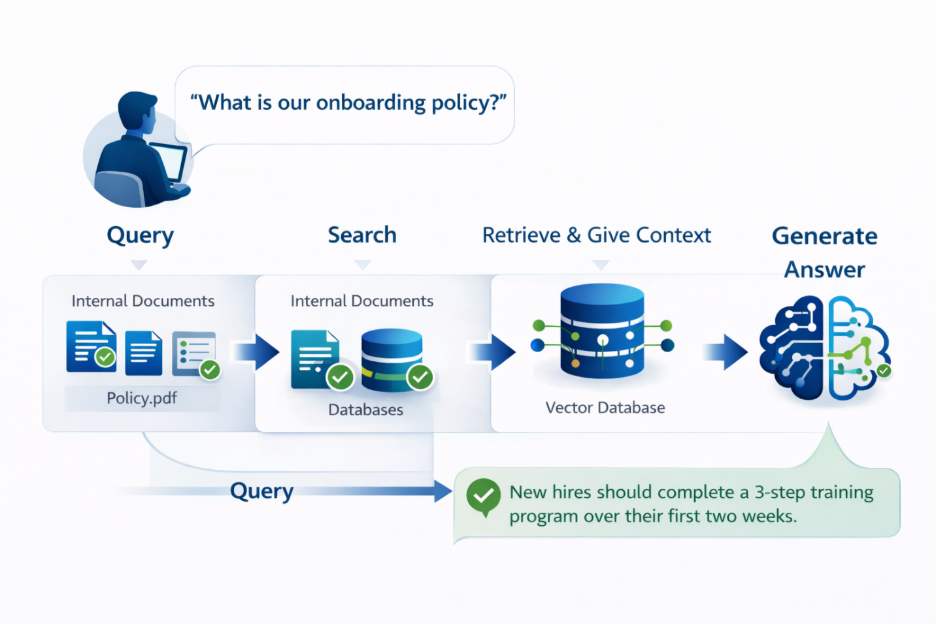
What makes RAG particularly suited to enterprise environments is not just its intelligence, but its structure.
- Your data (documents, PDFs, databases, etc.) is broken into meaningful chunks
- These chunks are converted into embeddings (vector representations)
- The embeddings are stored in a vector database
- When a user asks a question:
- The system retrieves the most relevant chunks
- Sends them to the language model
- The model generates an answer grounded in that retrieved content
How RAG Directly Optimizes Business Operations
1. Saving Time Across Teams
In many organizations, valuable time is lost searching across multiple tools, folders, and platforms. With RAG, employees can simply ask questions like:
- “What is our onboarding policy?”
- “Can you summarize this contract?”
- “What did we commit to this client?”
Instead of digging through documents, answers arrive instantly,The business impact becomes clear:
- Faster decision-making
- Reduced manual effort
- Higher overall productivity
Information becomes accessible when it is actually needed.
2. Improving Customer Experience
RAG is equally powerful in customer-facing use cases.
AI assistants powered by RAG can:
- Respond using verified company knowledge
- Provide consistent, accurate answers
- Reduce response and resolution time
Faster support leads to better customer experience, stronger trust, and improved retention.
3. Enabling Safer AI Adoption
One of the biggest concerns with AI in enterprises is risk.
RAG addresses this directly by grounding responses in:
- Approved documentation
- Verified internal knowledge
- Organizational policies and standards
Instead of unpredictable chatbot behavior, organizations gain controlled, auditable, and safer AI systems suitable for real-world deployment.
From Generic AI to Business-Aware Intelligence
The organizations seeing meaningful returns from AI are not necessarily those deploying the largest models. They are the ones connecting AI to the right knowledge at the right moment. RAG represents a shift from experimentation to architecture, embedding intelligence into how information flows through the business. Retrieval-Augmented Generation for Enterprises transforms AI from a generic assistant into a business-aware intelligence layer that understands context, reflects institutional knowledge, and supports real work. Many enterprises are aligning implementations with established AI governance frameworks.
Final Perspective
AI value does not come from generating more content. It comes from enabling better decisions. Retrieval-Augmented Generation allows enterprises to move from having vast amounts of information to actually using that information effectively. It bridges the long-standing gap between stored knowledge and operational action. As organizations move from AI pilots to production systems, this ability to connect intelligence with trusted data will increasingly define competitive advantage. RAG is not just another implementation pattern. It is becoming foundational to how modern enterprises make their knowledge usable and how AI becomes truly embedded in business performance.
Frequently Asked Questions (FAQs)
Retrieval-Augmented Generation (RAG) is an AI architecture that combines information retrieval with generative AI to produce responses grounded in an organization’s own data, making AI outputs more accurate, explainable, and context-aware
Traditional AI models rely only on pre-trained knowledge, while RAG retrieves relevant enterprise data in real time before generating a response. This ensures answers are based on current, verified business information.
RAG enables organizations to securely use their internal knowledge—documents, databases, policies, and systems, allowing AI to deliver business-relevant insights rather than generic answers.
RAG helps reduce time spent searching for information, improves decision-making speed, enhances customer support accuracy, and ensures knowledge is consistently accessible across teams.
Yes. RAG systems can be designed to access only approved data sources, ensuring responses are grounded in controlled, auditable information aligned with enterprise governance requirements.
RAG is designed to augment human expertise by providing faster access to knowledge, allowing employees to focus on analysis, strategy, and decision-making rather than manual information retrieval.
RAG works best with structured and unstructured enterprise data such as PDFs, knowledge bases, contracts, emails, CRM records, and operational documentation.
Because responses are generated from identifiable internal sources, organizations can trace answers back to original documents, making AI outputs more transparent and reliable.