
In just seven weeks, Open Road Lending transformed document intake from a fragmented, manual process into an AI-driven digital workflow. Before implementation, the customer portal handled only 0.6% of incoming documents, while the remaining 99.4% arrived through several other routes. After deploying the Insight AI–based Document Intake solution, the portal share surged to 26.8% more than a 44-fold increase. Every document submitted through the portal is now automatically read, assigned to a document type and verified by AI, with little to no human intervention, reducing manual handling, accelerating processing and creating a far more scalable intake operation.
About Open Road Lending
Open Road Lending is an online, direct-to-consumer auto finance company based in Fort Worth, Texas. Founded in 2009, it helps consumers refinance existing auto loans to lower their interest rate or monthly payment. Customers apply and complete their loans online, and Open Road works with banks, credit unions, and institutional investors to fund them.
Before a loan can be funded, Open Road’s funders review the customer’s supporting documents, such as a driver’s license and bank statements. That review is where this project started.
The Problem Was the Front Door, Not the Reading
Open Road Lending did not start this project because AI was available. It started because of how loan documents reached its funders. Customers sent documents by whichever route was easiest, and funders then opened each one, worked out what it was and checked it against the loan request by hand. No automatic email told customers when a status change meant documents were due, and the old fax queue and upload screens added routes that could not read a document at all.
Before launch, an application averaged 20.2 days (about 3 weeks) from Pending Sales to Sold. This process needed to change to speed up document processing and to handle the extra workload as ORL rapidly scales.
From January 2025 to early February 2026, only 0.6% of Open Road’s documents came through the customer portal. The rest arrived by LOS upload, email, text message, fax, and a handful of other routes. Email and text message alone carried 48.8%.
A model can only read what is shown. Everything Open Road received came in through channels where no reading could happen at the moment of upload. Funders then checked each document against the loan request by hand.
So, the AI-driven Document Intake had to do three things together: get customers to upload through the portal, read and classify each document as it arrives, and put everything a funder needs to decide in one place.
What We Built
The system sits on Azure Document Intelligence, Microsoft’s service for classifying documents and pulling fields out of them. Around it, we built pieces that make it usable day to day.
Upload With Feedback
Customers drag and drop JPG, JPEG, PNG, PDF, or HEIC files up to 10 MB. A progress bar runs while the document is read, then a plain message says whether it matched their application, matched but could not be checked, or needs a second look.
Classification and Extraction
Each upload is sorted by document type, and its fields are extracted. Anyone can override the AI’s choice, which triggers a fresh extraction, because the fields to pull depend on the type.
Document Split
If a customer scans a license and two bank statements into one file, the system separates it into one file by document type.
One Review Queue
Funders see the extracted fields, a confidence score for each, and the application data beside them, flagged as match, mismatch, or information. They approve or reject, and the next document loads on its own. A rejected document goes into an email to the customer with the funder’s reason, sent once per document.
A Plan for When the AI Is Down
A health-check service pings Azure Document Intelligence every four hours, and every hour once it finds it down. Documents uploaded during an outage are saved without being read. A recall service picks them up once the AI is back, along with anything still pending to review.
Upload and Review Flow
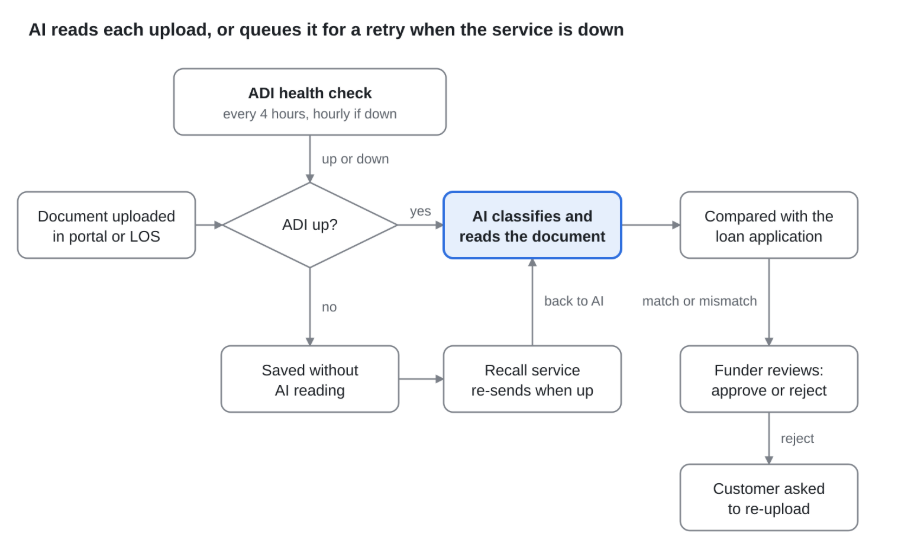
Flow showing the ADI health check, the AI classification path, the recall service when ADI is down, and funder review.
When the AI is up, a document is read at the point of upload. When it is down, the file is saved, and the recall service reprocesses it later. Funders then see matches and mismatches against the application either way.
What Changed
We compared the first seven weeks after launch (16 February to 5 April 2026) with the period before it. Three things moved.
Documents Started Arriving Where They Can Be Read
The portal’s share of intake rose from 0.6% to 26.8%. Email and text message fell from 48.8% to 13.3% combined. Of the documents that came through the portal, 99.8% were read by AI on upload.
The AI’s First Guess Is Usually Held Up
When a funder approved a document that the AI had classified on upload, the AI’s original document type matched the funder’s final one 95.5% of the time.
Applications Are Moving Faster
Average time from Pending Sales to Sold fell from 20.2 to 17.0 days (about 2 and a half weeks). The earlier stages moved the same way, though we want a longer window before we call it a trend.
Results at a Glance
| Measure | Before Launch | After Launch |
|---|---|---|
| Customer portal share of document intake | 0.6% | 26.8% |
| Email and text message share of intake | 48.8% | 13.3% |
| Portal documents read by AI | n/a | 99.8% |
| AI document type kept by the funder | n/a | 95.5% |
| Days, Pending Sales to Lender Review | 14.9 | 12.1 |
| Days, Pending Sales to Accepted | 17.6 | 14.7 |
| Days, Pending Sales to Sold | 20.2 | 17.0 |
| Funder review outcome | n/a | 66.3% approved, 33.7% rejected |
Intake figures are shares of all documents received in each period, so the two periods can be compared directly. Before-launch intake covers January 2025 to 9 February 2026. Before-launch cycle times cover 1 November 2025 to 1 February 2026.
Limitations
A Settled Trend
The results cover seven weeks. They show directions.
That AI Saved the Days
The post-launch cycle only counts applications that had already reached the next status by 5 April, so slower ones are missing, and the average can look shorter. Phase 1 also changed how documents arrive and how funders review them, so the saving cannot be credited to AI alone.
Field-Level Accuracy
95.5% compares the AI’s first document type with the funder’s final type, and only for approved documents. It says nothing about whether each extracted field was right.
An AI Error Rate From Rejections
About 64.5% of rejections include documents from channels where AI was not used.
We have not yet measured review time per document, funder hours or cost saved, or customer satisfaction. Those are the next numbers worth getting.
Ready to Streamline Your Document Processing?
Discover how AI-powered document processing can help your business reduce manual work, improve operational efficiency and build more scalable workflows.
Connect with Insight Consultants to explore how AI can address your document processing challenges.